
|
ARCHIVE 2023 |
2003 saw the arrival of the Sharpstar Hyperbolic Newtonian. Still with the Canon 250D though. |
|
|
|
10th December 2023Andromeda Galaxy, M31 |
A bit of an exploration to see if anything would be visible of the recently discovered OIII nebula adjacent to M31. Absolutely no sign of it in my images so much much longer exposures required. Unfortunately the weather did not cooperate with a wet and gloomy autumn here in Norfolk. This image is actually a 2- panel mosaic.
|
|
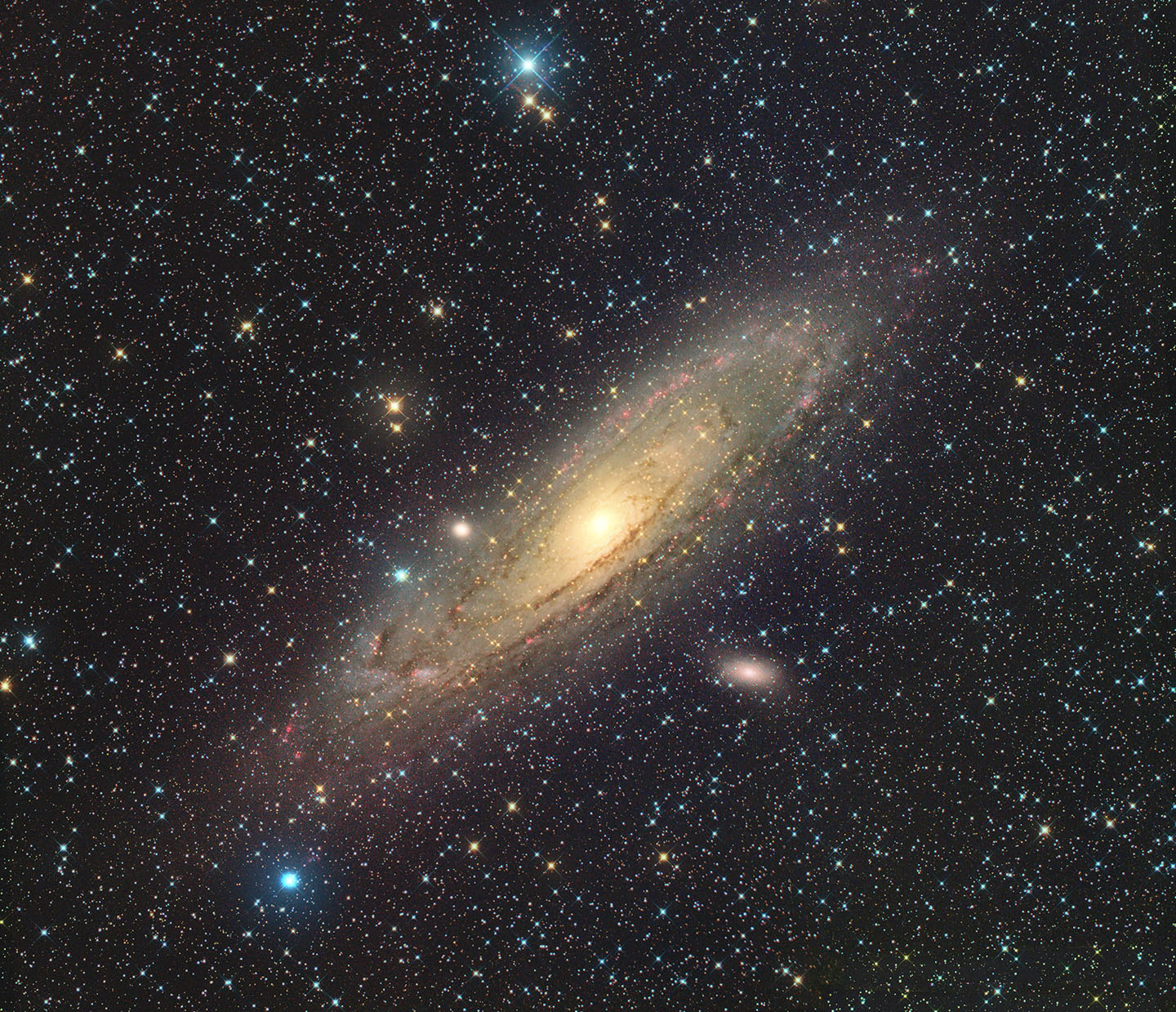 |
M31 Andromeda Galaxy
|
|
26th October 2023Vav den Bergh 152 (& Wolf's Cave Nebula) |
A more challenging object to push the Sharpstar and the Canon 250D a bit harder. Van den Bergh 152 is the bright blueish reflection nebula at the south end (bottom) of the dark nebula B175 (brownish colour). Sometimes referred to as Wolf's Cave Nebula - named after Max Wolf rather than its resemblance to a wolf. The red filaments are part of an ancient supernova remnant. The red and blue nebula above the red filaments is a planetary nebula, PN G111 0+11.6. All located in central Cepheus.
|
|
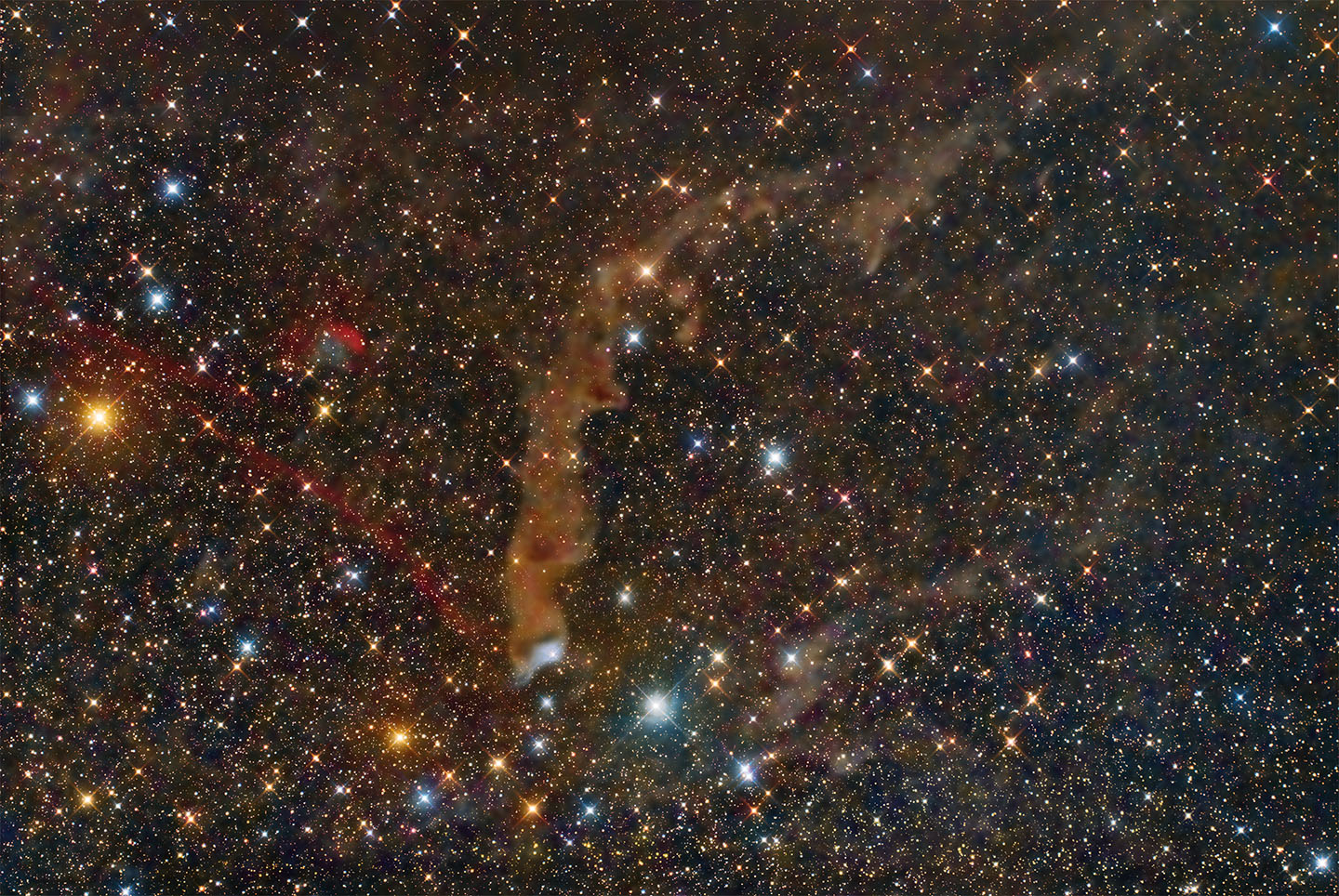 |
Wolf's Cave Nebula
|
|
9th October 2023The Coathanger Asterism |
Little bit deeper this time pushing the new scope a bit harder. For the H-alpha set of image I used a 12nm filter as these fast scopes cause the filters to go out of band. I need to get an offset one for fast scopes. Located in Vulpecula this is another fabulous asterism for small telescopes and binoculars. Also known as Brocchi's Cluster.
|
|
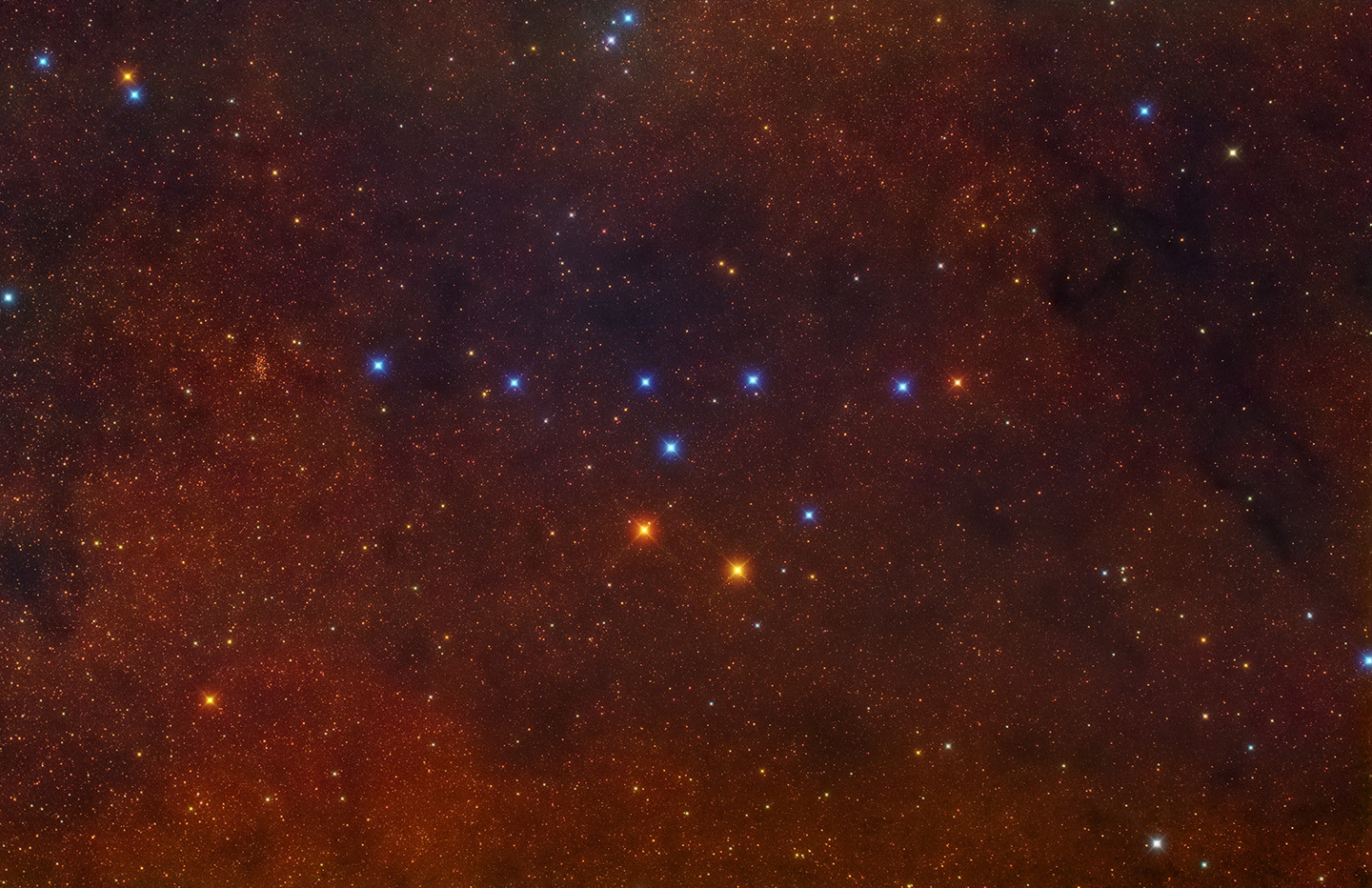 |
Coathanger Asterism
|
|
17th September 2023The Toadstool Asterism |
Something very simple to test everything was working. Some trouble initially with the asiair resetting its location back to China but when I had realised that and reset it to Norfolk it behaved as expected. Decided as this was try 1 to control the camera via a separate timer. Will try the asiair software to do this next time. Located in eastern Delphinus this is a fabulous asterism for small telescopes and binoculars.
|
|
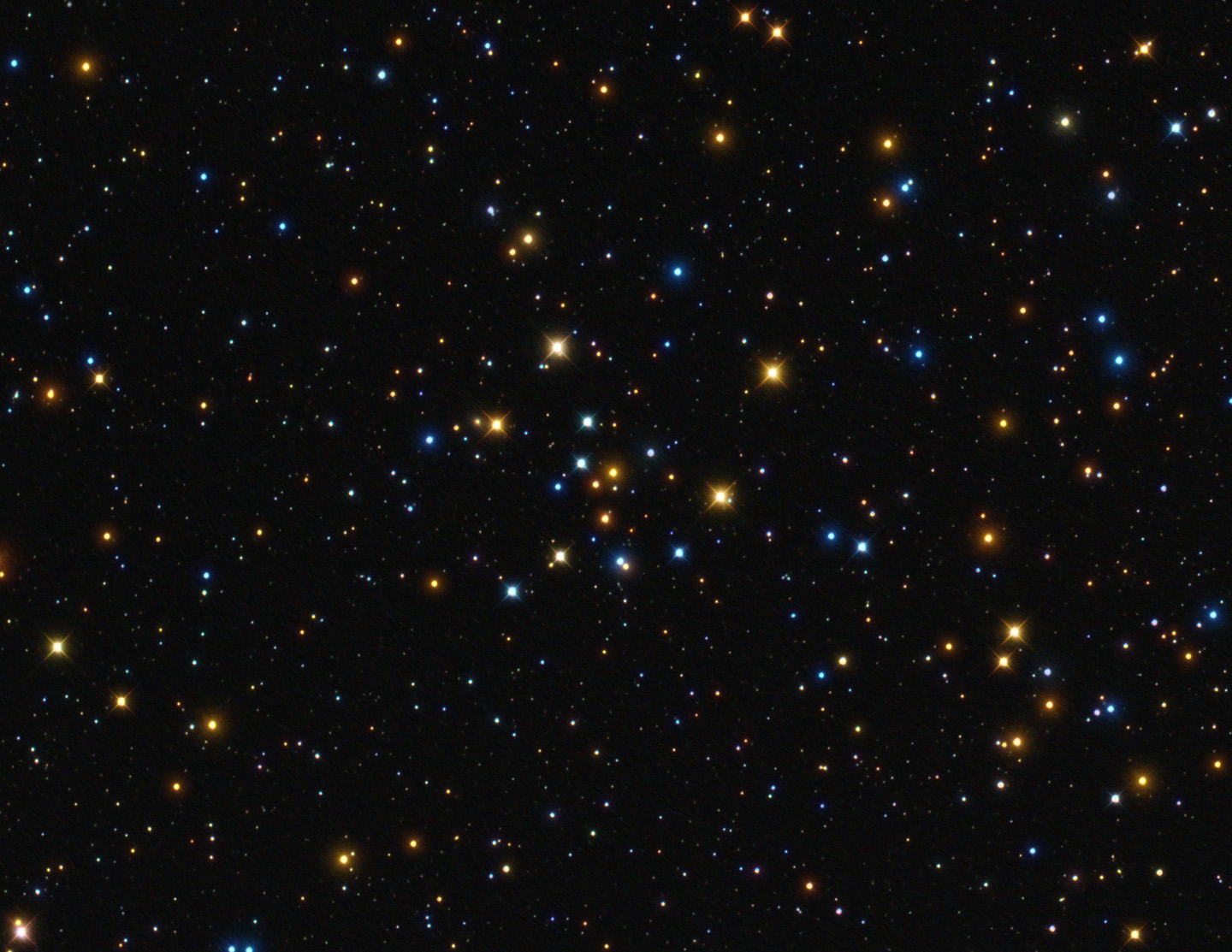 |
Toadstool Asterism
|
|
20th September 2023New Set-up for WInter 2023/4 |
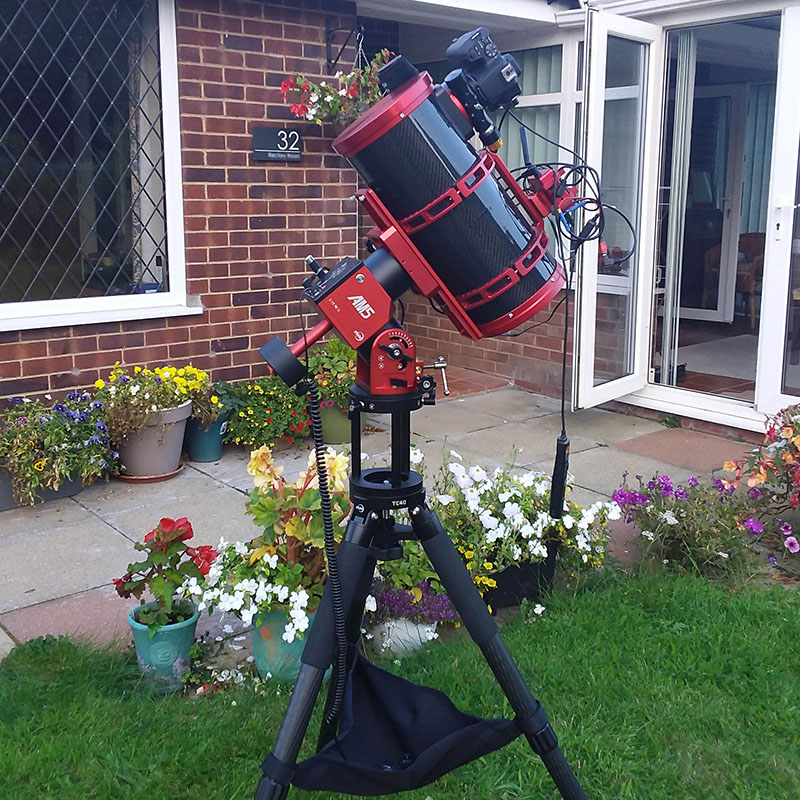
Over 2023 I sold all my old Astro gear - the RCOS 12.5 Ritchey-Chretien, Paramount ME, Apogee Alta U9 camera and the Takahashi FSQ106N. I came to the conclusion it was too onerous a task to start all over again rebuilding it plus a new observatory. Time for something simpler and lighter. I decided on the Sharpstar 130mmm F/2.8 Hyperbolic Newtonian on an ZWO AM5 mount and the ASIair mini controller/power box. I will continue with the Canon 250D for now and see how it goes. The whole set-up can be carried out and is then already fully assembled and cabled up. Just one power supply to connect when outside. The asiair software on my tablet connects wirelessly. The AM5 has no polar scope so I have mounted a laser (just sticking out over the AM5 control panel) to get close. The asiair software then can take over for final polar alignment. The laser can get close - within a 1/10th degree away. Currently I am parallel guiding with an asi120mm - I need to figure a way of going off-axis. Guiding accuracy is generally below 1 arcsecond. For the payload I am carrying a counterweight is not needed but as I had one handy put it on. In reality it is no where near big enough. The Samyang 135mm can also be mounted on the AM5 should I require an even wider field of view. |
|
|
1st May 2023Polaris and The Integrated Flux Nebula |
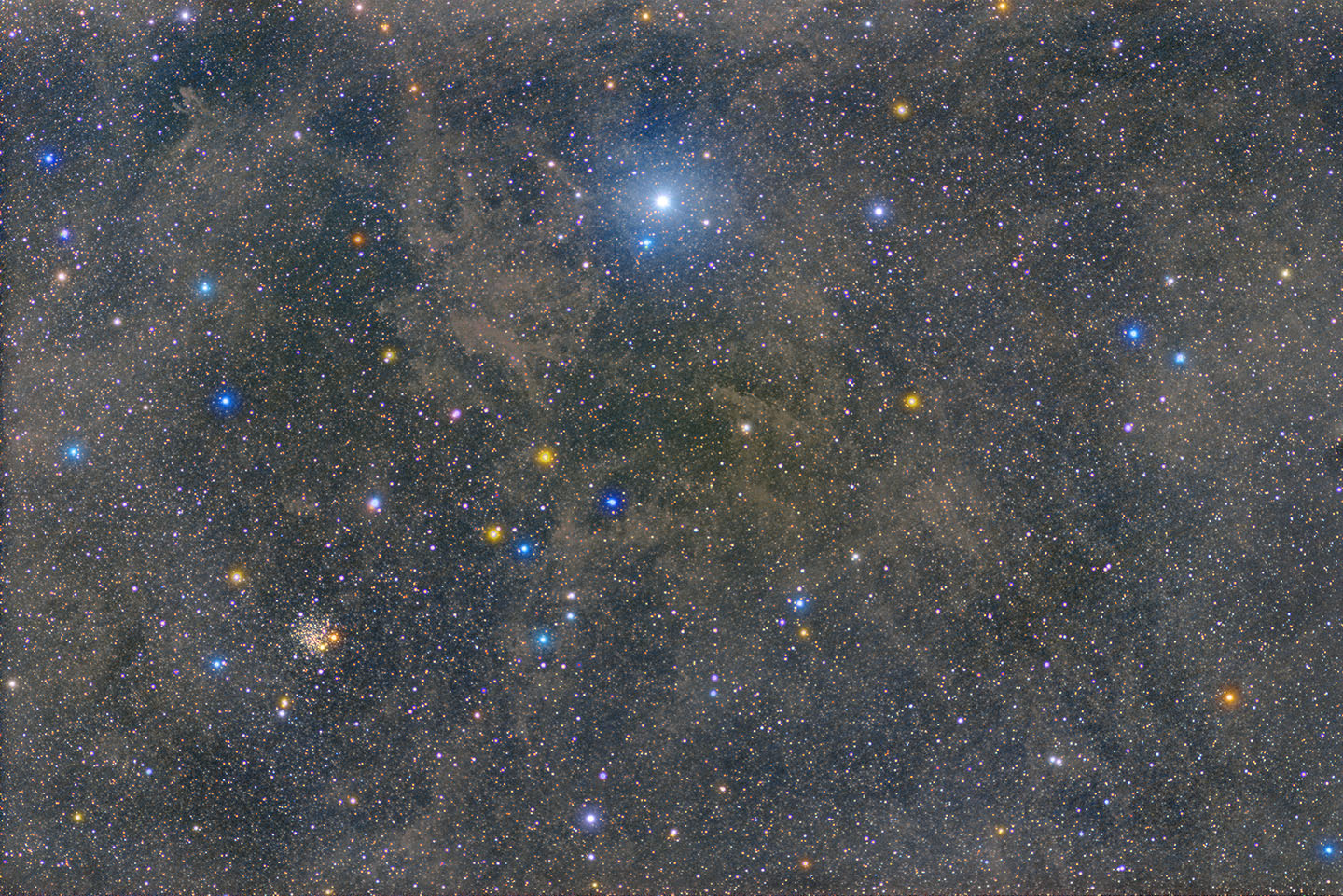
Buoyed with a bit of success with the Integrated Flux Nebula around M81 & M82 I thought I would try for another part of this huge nebula - this time around Polaris. WIth nights getting shorter I opted to leave the tracker and camera running all night and switch it off the following morning. I got 6 hours total - 10:00pm to 4:00am. Quite a relief in the morning to find the tracker and camera still there in my front garden. Perhaps confusingly this nebula is included in the Sharpless emission nebula catalogue as Sh2-178. Certainly what I recorded is the integrated flux nebula rather than H-alpha emission. The open cluster visible in the image is NGC188 (Caldwell 1). It is very old for an open cluster at around 6.8 billion years. The clue is that being located well above the plane of the Milky Way so it has been subject to much less interaction with other stars in the disk and so has managed to stay intact.
|
|
 |
Polaris & the Integrated Flux Nebula
|
|
15th April 2023The Integrated Flux Nebula |
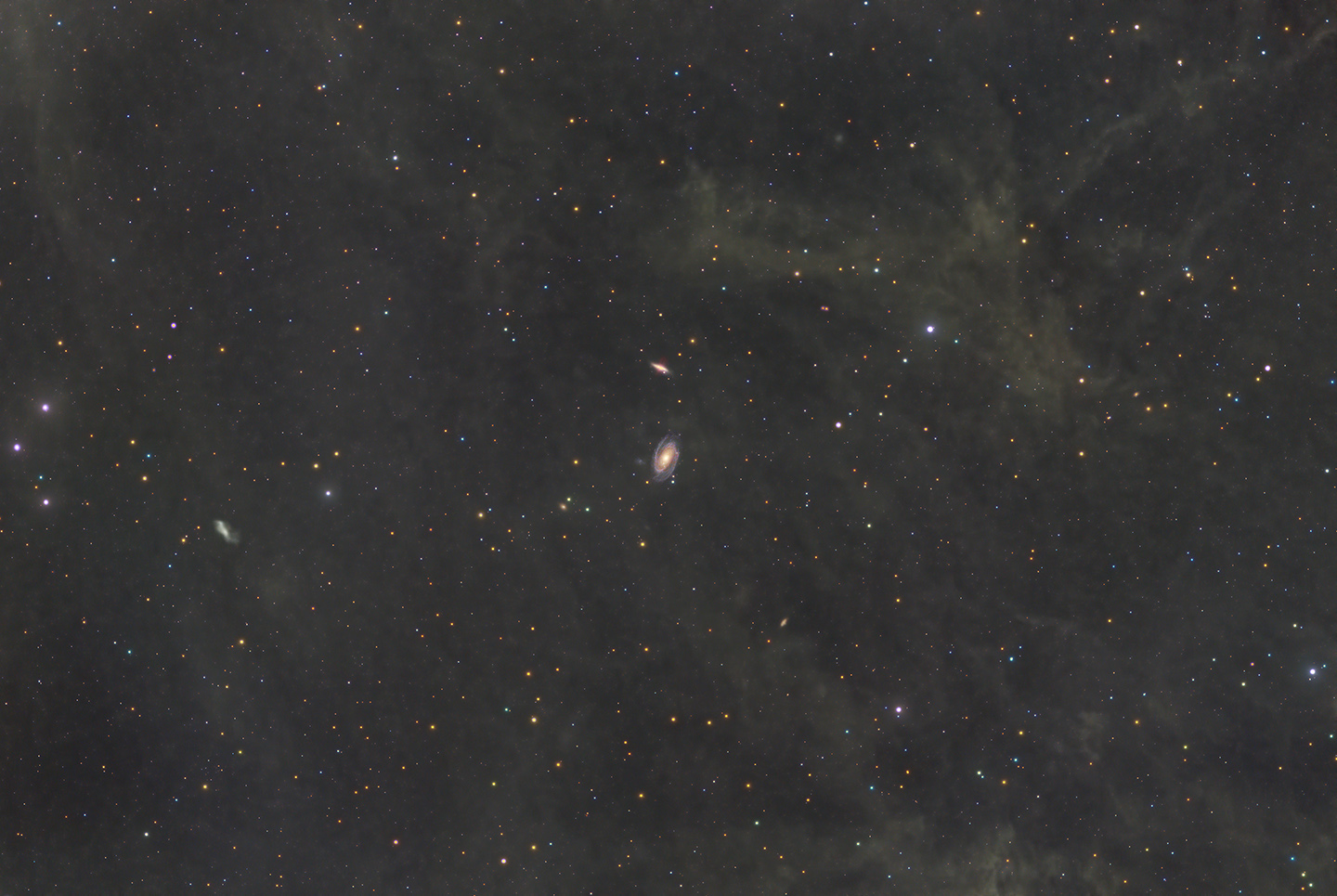
Quite a faint nebula but when running at f/2 well within rangs from my front garden! It did though need the bast part of 4 hours. This nebula stretches all the way to Polaris but I chose to centre my image on the galaxies M81 and M82. The new version of Siril was a big help with Starnet now called from a drop down menu. Saved a lot of time and the pre-stretch option seemed to help in producing a very clean starless image. The image has three distinctive zones. The nearest are the stars in the plane of the Milky Way disk. The second is the nebula - part of the Milky Way but above the disk. The third zone is background with the galaxies in the far distance. The Integrated Flux name come from the illumination of the nebula ie it is not illuminated by embedded stars but by the whole integrated light from the Milky Way - galaxy shine. According to Steve Mandel the nebula is composed of dust particles, hydrogen and carbon monoxide and other elements.
|
|
 |
The Integrated Flux Nebula
|
|
13th March 2023Central Orion - the Belt to M42 |
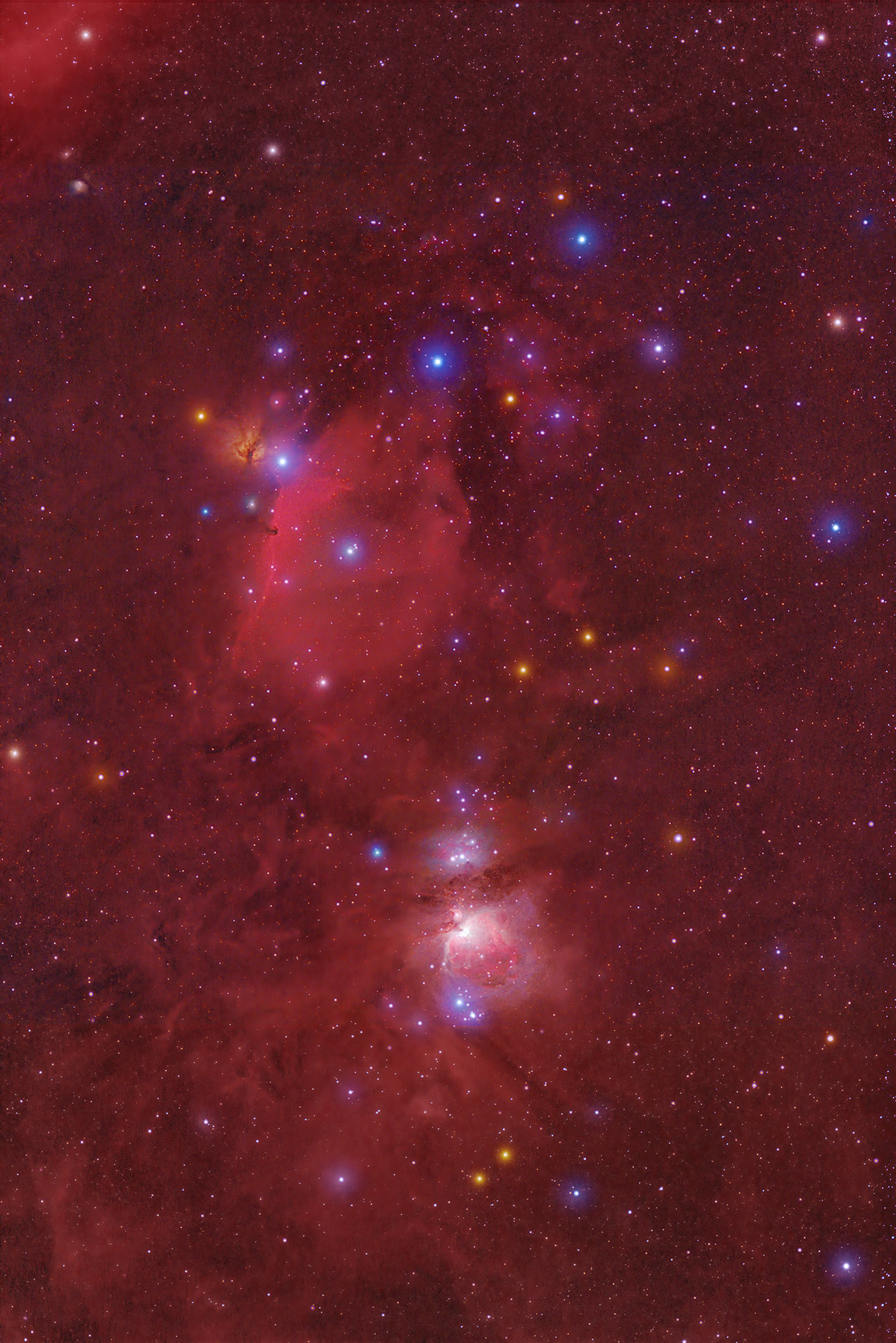
Quite a difficult area for me as it low over Norwich. Siril managed reasonably well to remove the light pollution.This area has to be shot with at some broadband data as the flame nebula's colour is yellowish, which narrowband filters do not record. One peculiarity with the Canon 250D was with this being a vertical shot then live view decided to show the image upside down which was a puzzle at first. Virtually the whole region is covered in nebula. It is wall to wall with no black sky! The main contenders are from north to south: the Flame Nebula, the Horsehead Nebula, the Running Man Nebula and the Great Orion Nebula. That's not counting M78 on the top edge and part of Barnard's Loop in the very top left corner.
|
|
 |
Central Orion
|
|
13th March 2023The Christmas Tree Cluster, the Cone Nebula & the Rosette Nebula Mosaic |
Monoceros might be one the most inconspicuous of constellations but it has some cracking deep-sky objects. In the top half of the image is Sh2-273, the Mon OB1 molecular cloud. At its centre is the open cluster NGC2264 , commonly called the Chritmas Tree Cluster. Its brightest star, the binary S Mon, is one of the primary ionising stars of the nebula although several others are now known. Below it is the dark nebula commonly called the Cone Nebula, actually a pillar of gas and dust containing an infrared source. The blue reflection nebulae are VdB 77-82. In the botton half of the image is Sh2-275 containing the famous Rosette Nebula, all part of Mon OB2, which is believed to be twice as far away as Mon OB1. At the centre of the Rosette is the open cluster NGC2244, which ionises the nebula and its fierce stellar winds has created the cavity at its centre.
|
|
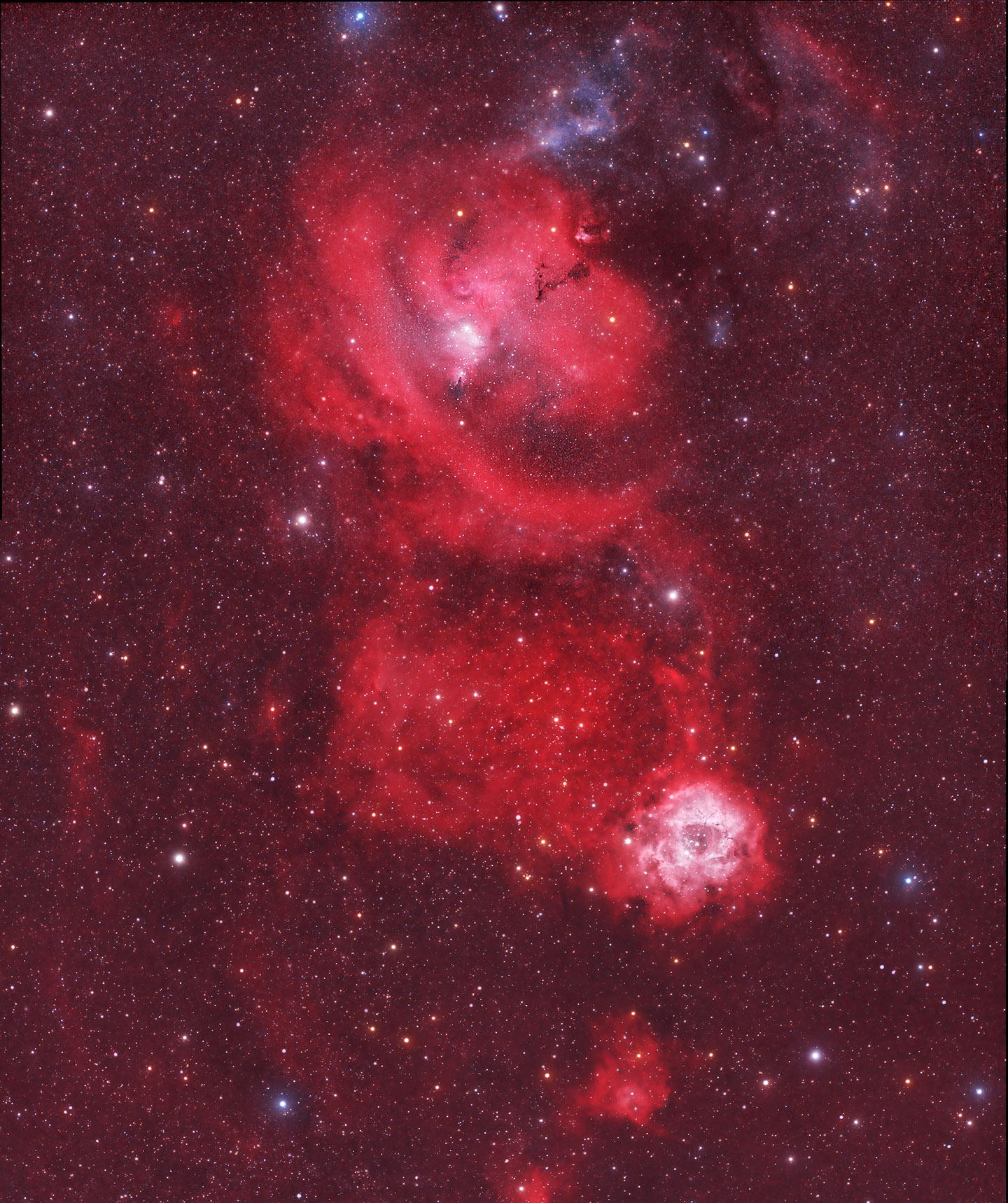 |
Cone and Rosette nebulae.
|
|
5th March 2023The Jellyfish Nebula, IC443 (Sh2-248) |
The Jellyfish Nebula is located at the centre of this image just to the left (east) of the bright star Eta Geminorum. Believed to be a supernova remnant but because of its proximity to and interaction with dense molecular clouds it is a very complex object. So much so thats its age i.e. when the supernova explosion occurred, is only vaguely known as between 3,000 and 30,000 years ago. The likely remnant pulsar star is the neutron star CXOU J061705.3+222127. The bright nebula bolow the Jellyfish is NGC2175 commonly known as the Monkey Head Nebula. M35 is also in this image, directly above the Monkey Head Nebula towards the top.
|
|
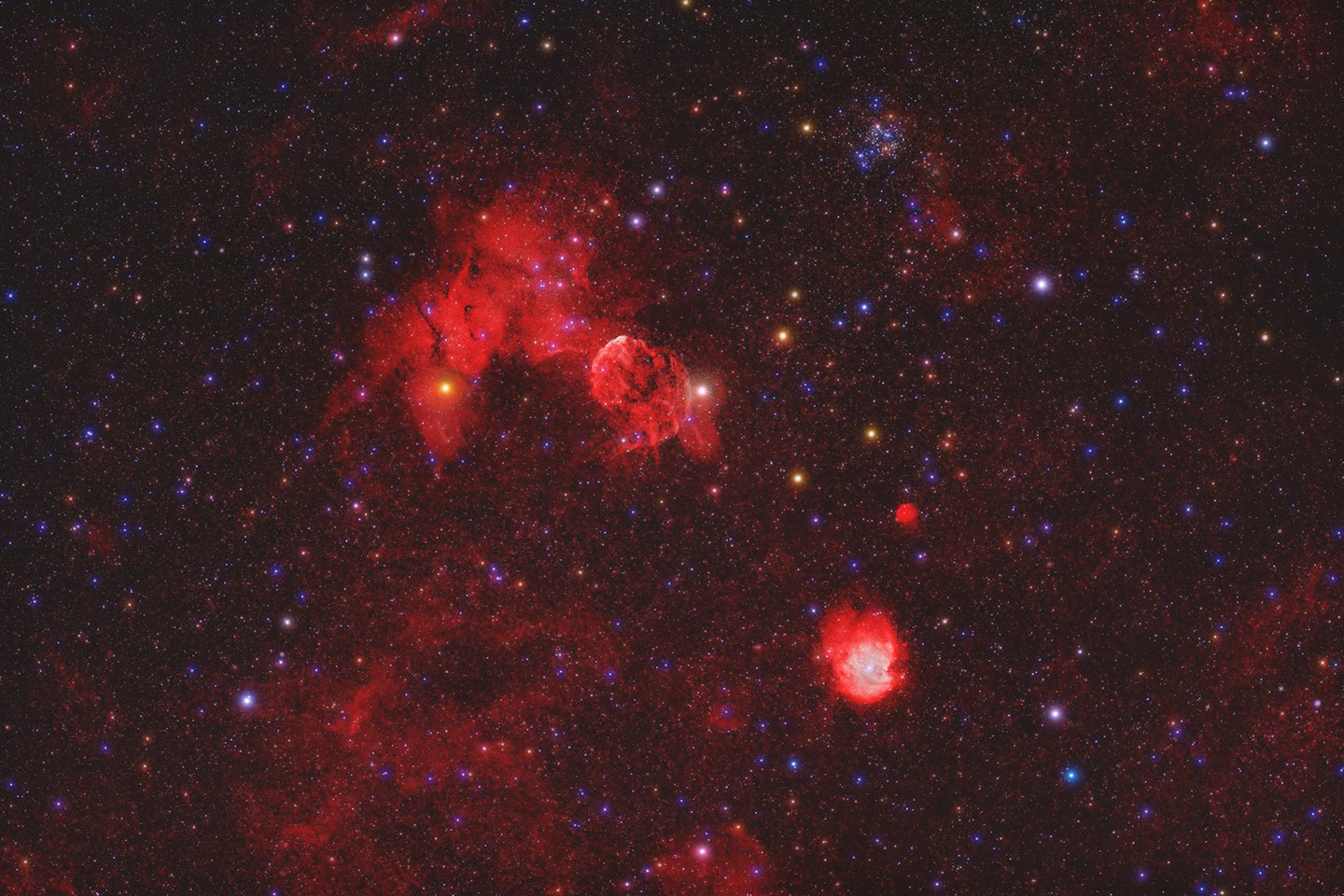 |
Jellyfish Nebula
|
|
19th February 2023The Flaming Star Nebula,IC405 (Sh2-229) |
This nebula is a combination of an emission (red) and reflection (blue) nebula energised by the irregular variable star AE Aurigae. This star is a runaway star most likely ejected during an interaction of two binary star groups. This event probably also ejected, in the opposite direction, Mu Columbae. The star 53 Arietis and Iota Orionis may also have been involved. This event has been traced to the Trapezium cluster in the Orion Nebula around two million years ago. So AE Auriga was not formed within the the Flaming Star Nebula but is just passing through it at high speed. Also in the image is the Emission Nebula NGC1893 (with the Tadpoles) and the Open clusters M38 and M36.
|
|
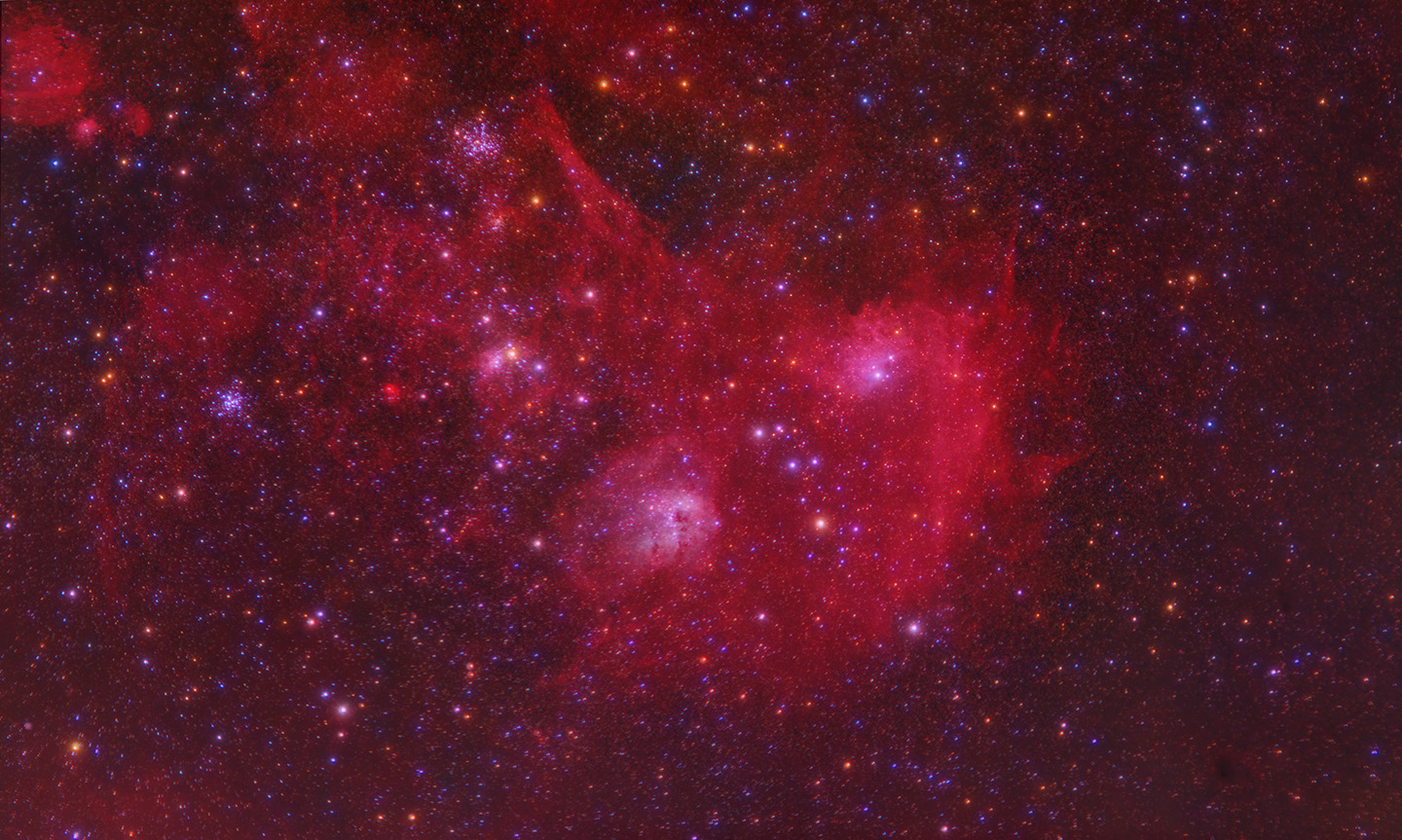 |
Flaming Star Nebula
|
|
10th February 2023Twin Comets, ZTF C/2022 E3 & Atlas C/2022 U2 |
The "Green Comet" ZTF E3 was fading now but on the 6th February is was to pass very close to Comet Atlas U2 just to the south of Capella. Same exposures as last time but no gas tail on ZTK was visible but just to its west (right) was the very much fainter Atlas comet. This was around 11th to 12th magnitude so pretty faint for a simple 135mm lens but it was clearly evident. This comet has 936.5 year period.
|
|
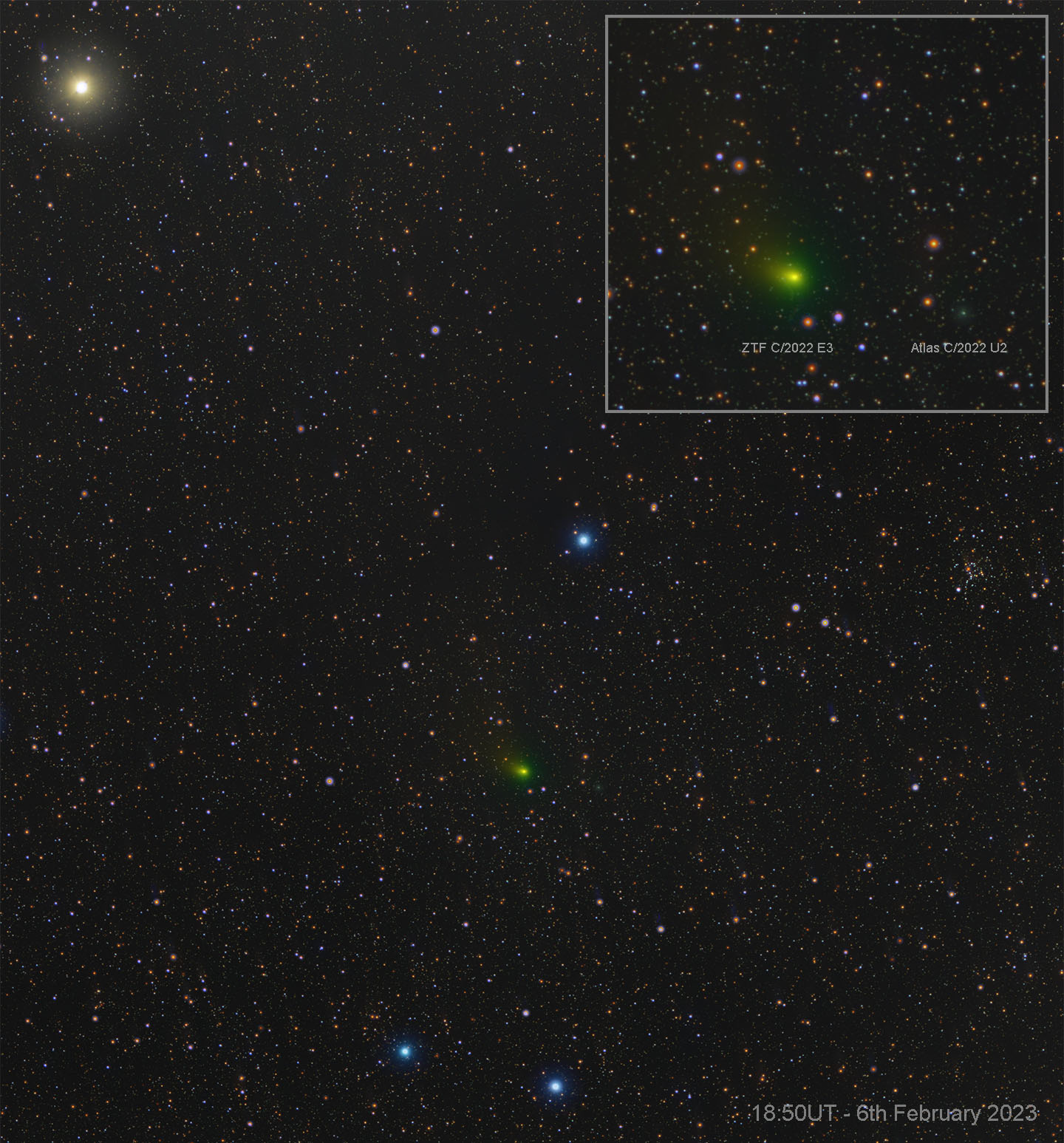 |
Twin Comets and Capella
|
|
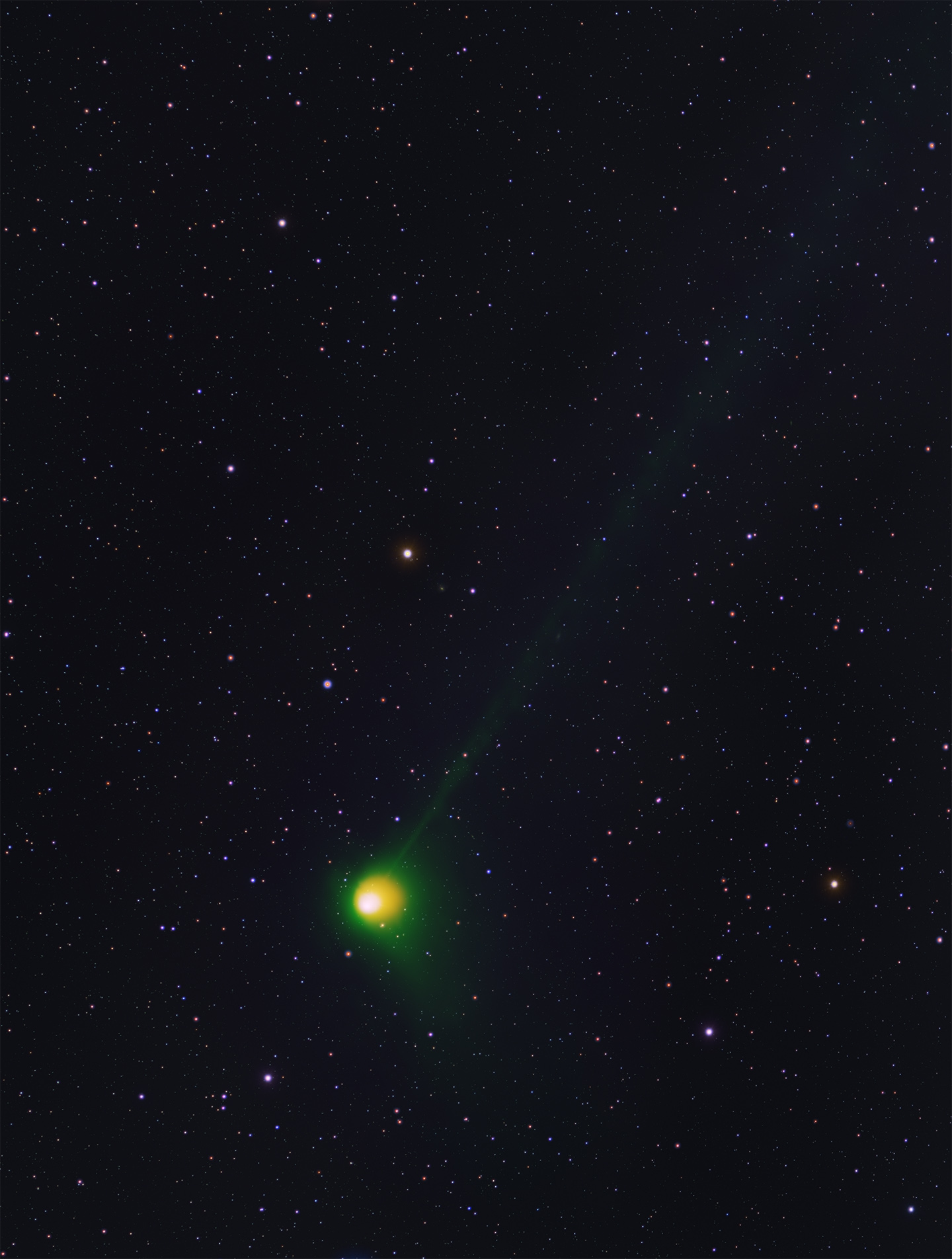
1st February 2023The Green Comet, ZTF C/2022 E3 |
It was a frustrating week with continuous cloud cover as the comet rose higher in the northern sky. At last on the 30th January it was clear and although there was a dazzling Moon almost at the zenith I was able to get a run of images. With the strong moonlight then 15 seconds was about the limit. Comet E3 is a long period comet from the Oort cloud with an orbital period of around 50,000 years. A long time to wait if you missed it this time! Commonly called the Green Comet, which is due to the effect of sunlight on its molecules, especially carbon and cyanogen. The comet reached its perihelion (closest to the Sun) on 12th January 2023, at a distance of 103 million miles so outside the Earth's orbit. Its closest approach to Earth was on 1 February 2023 at a distance of 26 million miles.
|
|
 |
The Green Comet
|
|
22nd January 2023The California Nebula, NGC1499 |
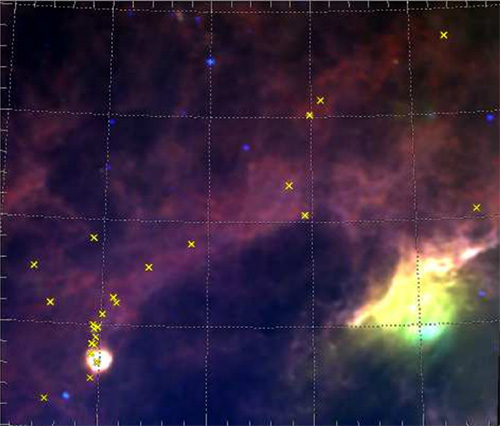
The California Nebula in Perseus is just the brightest part of the giant California Molecular Cloud. However, its brightness is nothing to do with the molecular cloud as it is ionised by the runaway O star, Menkib, which is not associated with the cloud i.e. it is just coincidently passing through. The nebula gets its name from its brightest part being similar in shape to California. The California Molecular Cloud is about the same mass as the Orion A molecular cloud and is one of the most massive molecular clouds within 2000 light years of the Sun. However, despite its large mass, it has a much lower star forming rate than Orion A so it is very much a sleeping giant. (Ref Lada et al. 2007 & 2017). Right is an IRIS 3-colour image of the California Molecular Cloud (Lada et al. 2007). The brightest spot to the right is the California Nebula which lends it name to the cloud. The other bright spot to the bottom left in NGC1579 and the yellow crosses denote young stellar objects.
|
|
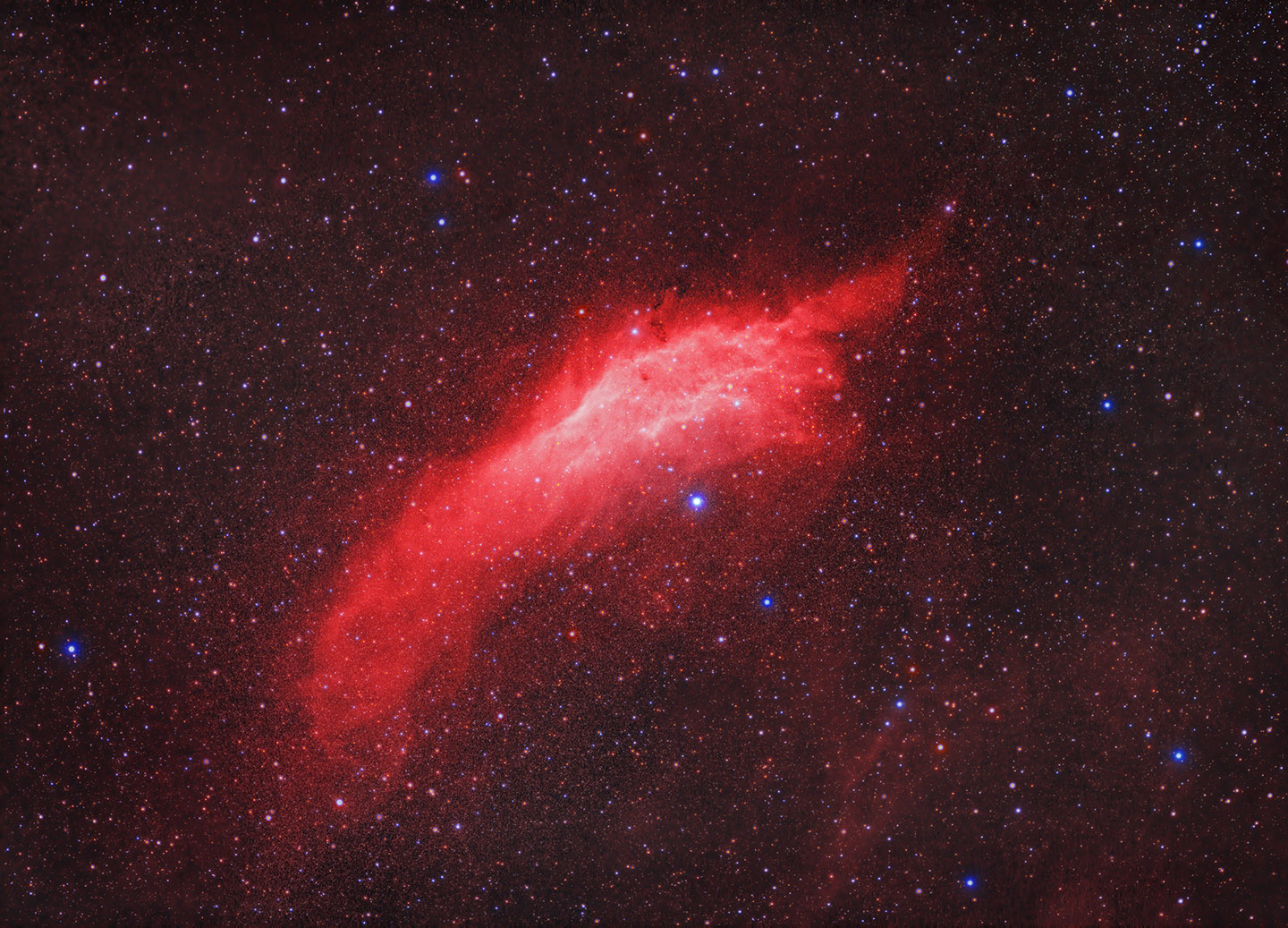 |
California Nebula
|
|
15th January 2023The Heart & Soul Nebulae (IC1805 and IC1848) |
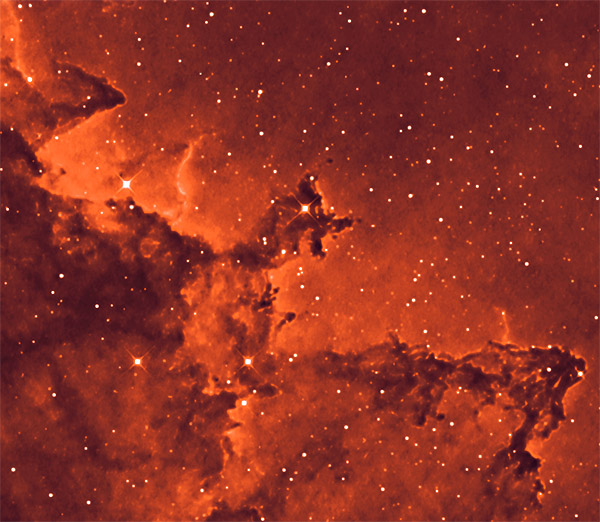
This pair of bright emission nebulae are located in the Perseus arm of the Milky Way. Strickly speaking their catalogue numbers refer to the open star clusters within them. They were catalogued well before the extensive nebulae around them were known but today their IC numbers are generally taken to be the nebulae. In the case of the Soul Nebula (left) in film astrophotography days this was known as the Foetus nebula which probably is a better description than the Soul. Within the Heart Nebula but very small and insignificant in the main wide field image below is what I call the Dragon's Head (right). This was shot with my RCOS 12.5 inch telescope with a focal length of 2850mm - somewhat longer than the 135mm Samyang lens!
|
|
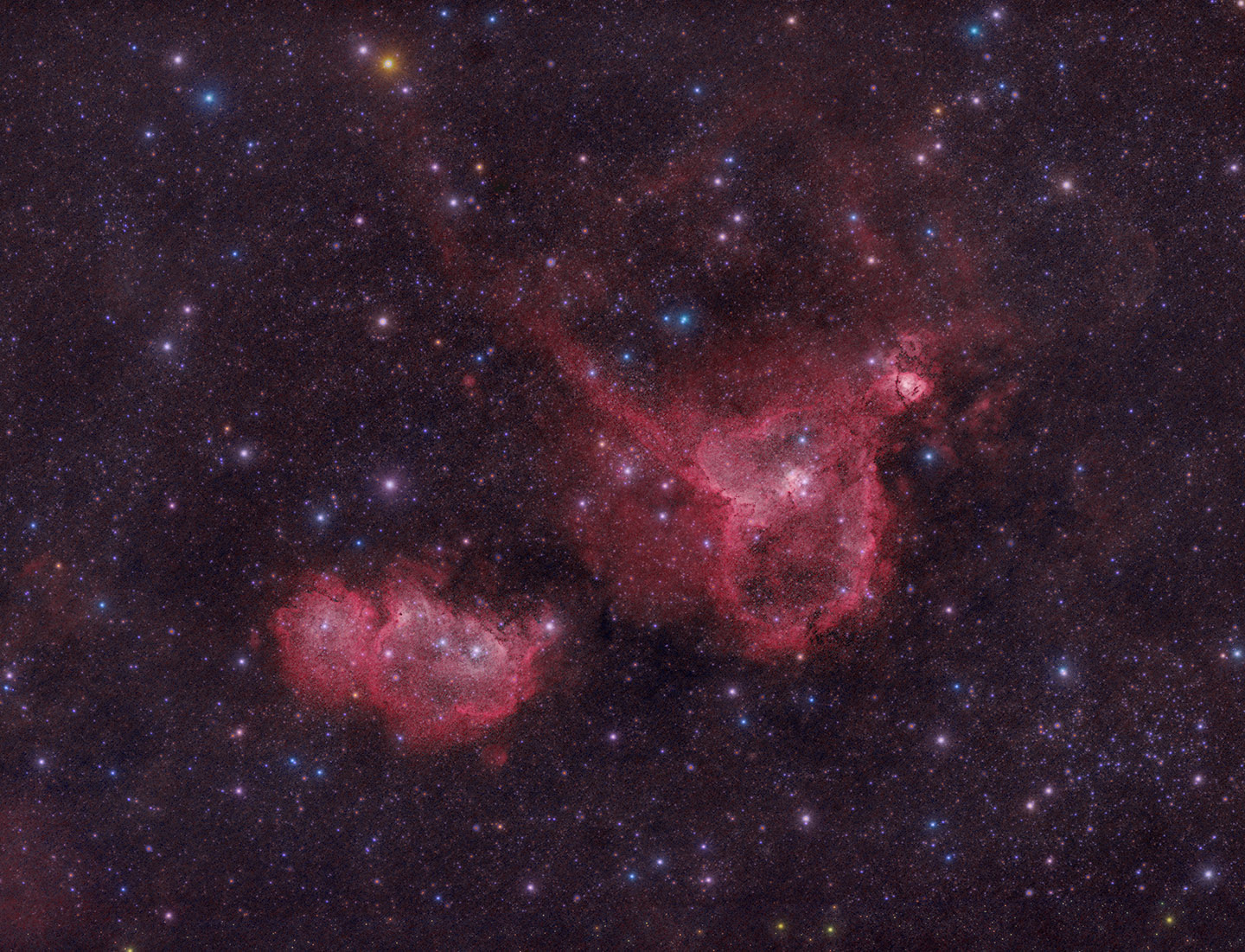 |
The Heart & Soul Nebula
|
|
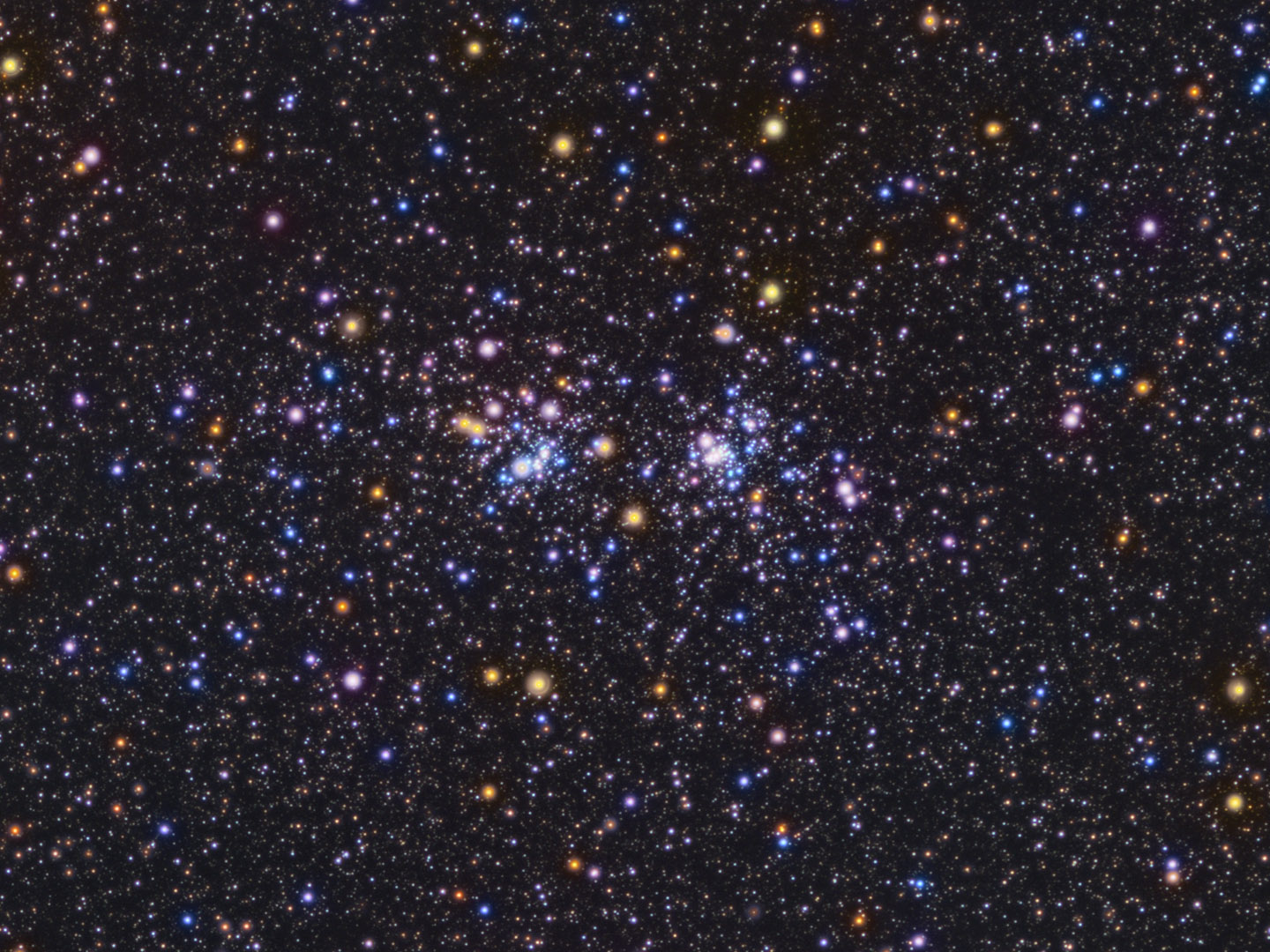
1st January 2023The Double Cluster in Perseus |
When using the dual narrowband filter (OIII and H-alpha) the star colours are very poor. So I spent most of this night night shooting a few objects without filter (i.e. broadband). These could be then used with deep narrowband images later. However, in the case of the Double Cluster the broadband images were more than enough on their own. Originally referred to as h Persei and χ (chi) Persei, the Double Cluster consists of the twin open clusters NGC 869 and NGC 884. Patrick Moore also included the pair as No. 14 in his Caldwell catalogue. Away from light pollution they are easily visible to the naked eye. For many years there waa a debate as to whether they were asscoiated or a chance alignment. The answer was really pretty obvious - they are associated. They have the same very young age (14 million years) and are both are approaching us at the same speed. Togther they have a large mass equivalent to 20,000 Suns.
|
|
 |
Veil Nebula
|
|
Please remember these images are copyright David Ratledge. Contact me before any use is made of them.